Contribution to Planetary Defense (activities to protect humanity from the ultimate natural disaster of a celestial Earth collision)
Demonstration of technology to prevent small solar system bodies from colliding with the Earth, which could cause serious damage to human society, and investigation into the nature and origin of small solar system bodies
When an asteroid or comet collides with the Earth, it can cause a tragic disaster. Even a celestial body several tens of meters in size can cause a severe regional disaster if it were to collide with the Earth. The frequency of such collisions is said to be once every few decades to 200 years.
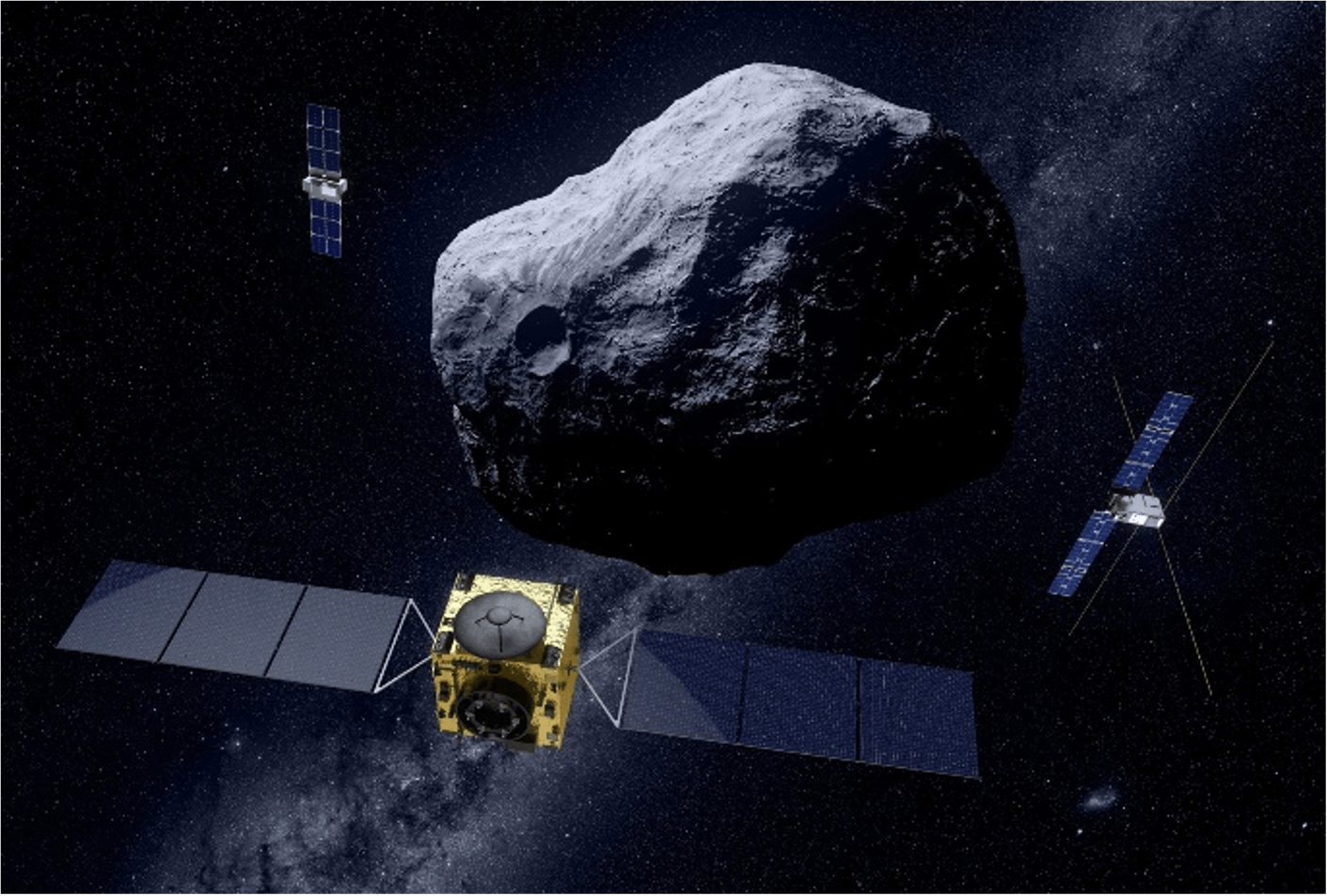
The celestial bodies that could collide with the Earth in the near future and cause damage are not the 10km diameter objects that are thought to have caused the extinction of the dinosaurs but rather are only tens to hundreds of meters in size. A realistic way to avoid collisions with the Earth would be to collide with spacecraft and change its orbit. NASA crashed the DART spacecraft into Dimorphos, a satellite of the asteroid Didymos, in September 2022 and confirmed the orbital change. To investigate the efficiency of the collision, information such as the asteroid's size, density, and surface properties is required. Hera is a spacecraft launched by ESA in 2024 that will rendezvous with Didymos at the end of 2026 to conduct detailed observations. JAXA will contribute to both the demonstration of asteroid collision avoidance technology and the investigation of the nature and origin of small celestial bodies.
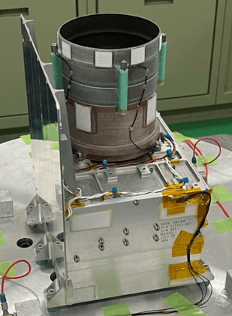
Hera is ESA's asteroid mission and the first full-scale planetary defense program in history in collaboration with NASA's DART mission. JAXA developed the thermal infrared camera TIRI, which is an improved version of Hayabusa2's TIR, and installed it on Hera. Observations of the asteroid Didymos and its satellite Dimorphos using TIRI will make a significant contribution to research into the effects of the DART collision.
Japan has world-leading knowledge of asteroid science, including small body topography, collision science, asteroid dynamics, and thermal properties, cultivated through the Hayabusa and Hayabusa2 missions. Japan will contribute strongly to the analysis and interpretation of the data obtained by Hera.
Although the asteroid Dimorphos has been the subject of collision experiments by spacecraft, there is no immediate possibility that it will collide with the Earth in the future. However, there is one asteroid whose approach to the Earth is drawing attention. This is asteroid Apophis. Estimated to be about 340 meters in size, it will pass within approximately 32,000 km of the Earth on April 13, 2029. This marks the first time in recorded history that an asteroid of this size has come this close to the Earth.
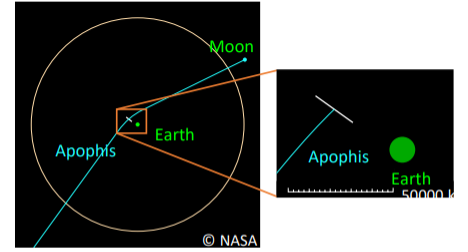
Taking advantage of this opportunity, various countries are advancing plans for Apophis exploration. The European Space Agency (ESA) will conduct a rendezvous exploration of Apophis by the RAMSES (Rapid Apophis Mission for SpacE Safety) mission. JAXA will provide the Thermal Infrared Imager (TIRI) and thin-film light weight solar array paddles (SAP) for the RAMSES mission. Furthermore, JAXA plans to participate in the Apophis exploration as an ESA-JAXA joint mission by providing a launch opportunity using the H3 rocket.

JAXA President Yamakawa (left) and ESA Director General Aschbacher (right)
Additionally, JAXA's Deep Space Exploration Technology Demonstrator DESTINY⁺, currently under development, is scheduled for launch in 2028 aboard an H3 rocket, sharing a launch vehicle with RAMSES. The primary objectives of DESTINY⁺ are to understand the transport pathways of dust, considered a source of life-originating materials for the Earth, by clarifying the distribution of interplanetary dust and meteor shower dust, as well as the physicochemical composition of dust around the asteroid Phaethon and the true nature of Phaethon itself. Furthermore, flybys of multiple celestial bodies, including Apophis, are under consideration.
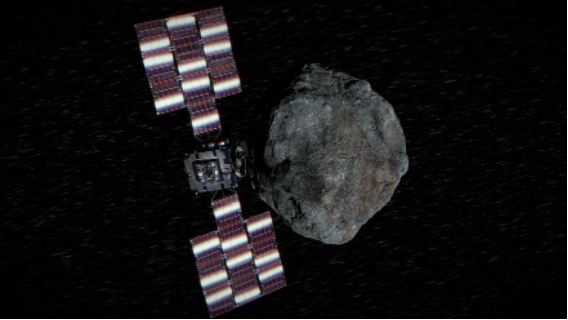
To advance these initiatives across JAXA, a Planetary Defense Team has been established within JAXA, promoting planetary defense activities to protect our planet from small solar system bodies.
-
We will contribute to the sustainable development of space development by improving our technology related to deep space probes.

-
In response to the ultimate natural disaster of a celestial Earth collision, we will contribute to disaster prevention by developing collision avoidance technologies and elucidating the physical properties of colliding celestial bodies.