Contribution to Planetary Defense (activities to protect humanity from the ultimate natural disaster of celestial bodies colliding with the Earth)
Celestial bodies colliding with the Earth are the ultimate natural disaster
When an asteroid or comet collide with the Earth, it can be a very serious disaster. Even a celestial body several tens of meters in size can be a major regional disaster if it hits the Earth. The collision frequency of such objects is said to be once every 100 to 200 years.
Earth collisions by celestial bodies can be predicted very accurately for decades to come if we find celestial bodies and make accurate orbital estimates. It is important to find objects that can approach Earth and make follow-up observations.
To avoid a celestial body colliding with the Earth, it is important to know the physical properties of the colliding object and to consider how to avoid a collision or how to minimize damage if it is not possible.
Hayabusa2 extended mission acquires technology and data for planetary defense
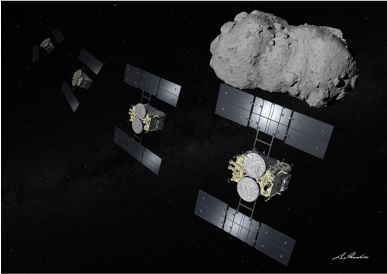
Hayabusa 2 will conduct close, high-speed fly-by exploration of asteroid "Torifune" in 2026. Obtaining the technology to make the spacecraft fly-by in an accurate orbit will lead to the technology to make the spacecraft hit the asteroid and change its orbit.
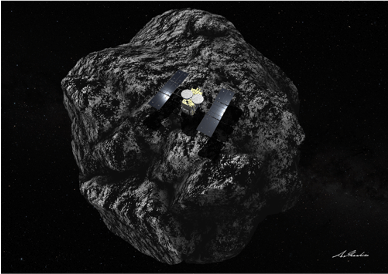
Hayabusa 2 will reach and explore asteroid 1998 KY26 in 2031. The asteroid is estimated to be about 30 m (or about 11 m) in size, and it is estimated that such an object hits Earth once every 100 to 200 years. It's important for planetary defense to know its physical nature.
-
We will contribute to the sustainable development of space development by improving our technology related to deep space spacecraft.
-
In response to the ultimate natural disaster of celestial bodies colliding with the Earth, we will contribute to disaster prevention by developing collision avoidance technologies and elucidating the physical properties of colliding celestial bodies.